Cost Per View (CPV) Calculator
Eye on the prize! Track video ad value with this CPV calculator!
What is Cost Per View (CPV)?

Unlock the True Cost of Every View and Optimize Video Campaigns for Peak Performance with the CPV Calculator
Tired of guessing how much your video ads are truly costing you? Ready to take control of your video marketing budget and ensure every view drives value? Introducing the CPV Calculator, your secret weapon to understand the true cost of every video view, optimize campaigns for maximum ROI, and create a viewing experience that captivates audiences and ignites results.
Here's why it's your indispensable guide to video ad mastery:- See the True Cost of Every View: Calculate your exact CPV with pinpoint accuracy, revealing the cost-effectiveness of your video campaigns and giving you clear insights into your ad spend. No more surprises, just actionable data to guide your decisions.
- Optimize for Maximum Impact: Use CPV insights to identify the most efficient video ad platforms, targeting strategies, and creative approaches. Allocate your budget wisely and ensure you're reaching the right audiences with engaging content that drives results.
- Track Performance Like a Pro: Monitor your CPV over time to assess campaign effectiveness, identify trends, and make data-driven adjustments. Continuously refine your strategy and ensure you're getting the most out of every video ad investment.
- Benchmark Against the Best: Compare your CPV to industry benchmarks and competitors to understand your position in the market and identify areas for improvement. Stay ahead of the curve and ensure your video ads are delivering competitive results.
- Drive Meaningful Engagement: Focus on creating video content that not only attracts views but also sparks engagement and drives desired actions. Use CPV insights to understand what resonates with your audience and optimize your videos for higher engagement rates and conversions.
The CPV Calculator is more than a tool—it's your video ad whisperer, your budget bodyguard, and your key to unlocking the full potential of your video marketing efforts.
Remember
In the world of video marketing, views matter, but value matters more. And the CPV Calculator empowers you to achieve both. Embrace the clarity, control, and strategic insights it provides. Start using the CPV Calculator today and start turning views into value that fuels your business growth!
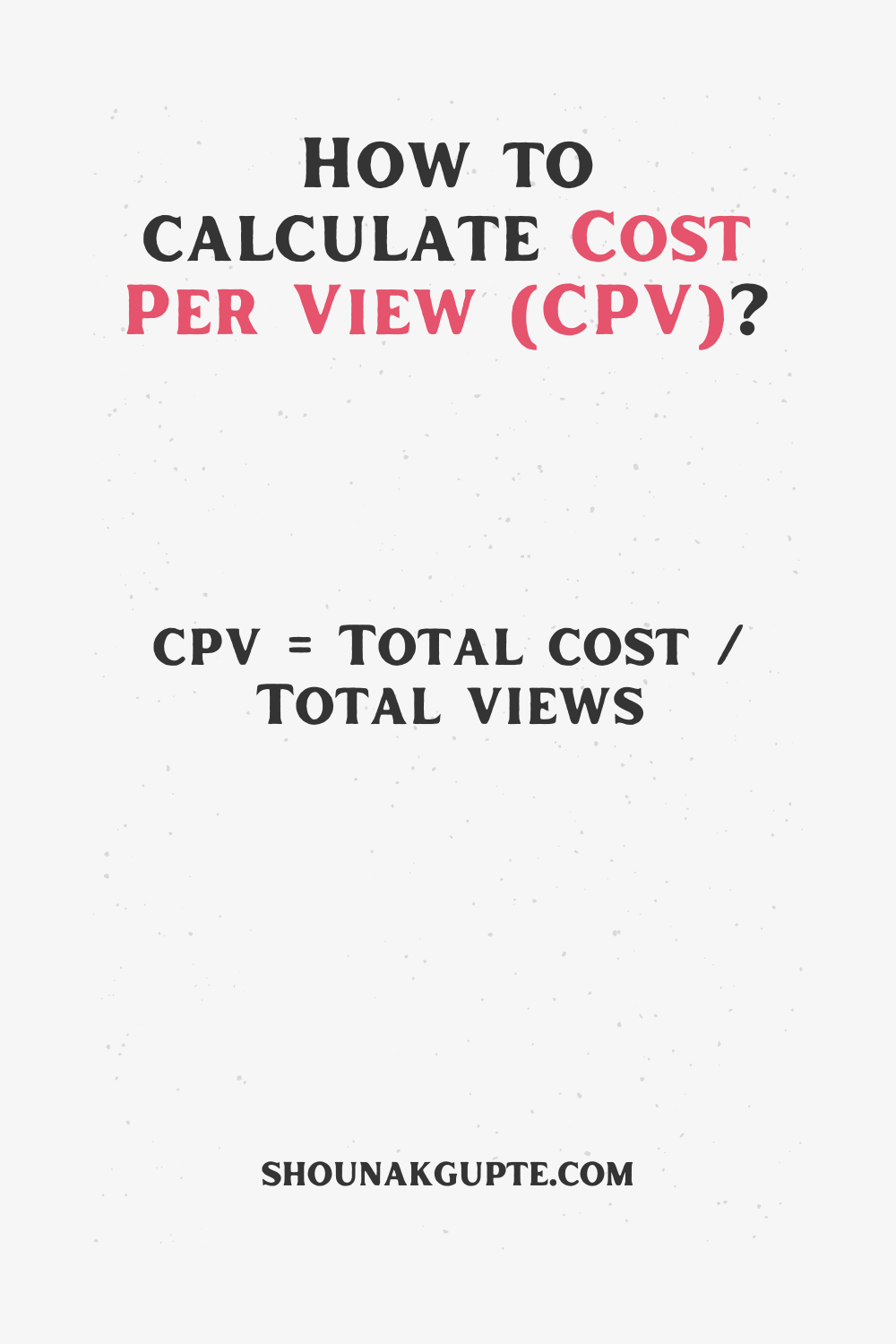
Cost Per View (CPV) Formula - How To Calculate Cost Per View (CPV)?
Help!
Total Cost: The overall amount spent on a video advertising campaign. Valid inputs are positive numbers.Number of Views: The total count of times viewers actually watched the video ads. Valid inputs are positive numbers.
Cost Per View (CPV): The average cost you pay for each view of your video ad. It's a key metric for understanding the cost-effectiveness of video advertising campaigns.
Your Input
The Cost Per View (CPV) of your ad is $0.
Benchmarks!
Unfortunately, there's no universal "industry benchmark" for Cost Per View (CPV) due to significant variations across:- Industry: Healthcare & Insurance might have high CPVs (~$0.07), while Beauty & Personal Care are lower (~$0.03).
- Platform: YouTube averages ~$0.048, while Facebook averages ~$1.72 per video view (different metric).
- Video type and length: Shorter, engaging videos often see lower CPVs.
- Target audience: Reaching niche audiences often costs more.
- Research CPV benchmarks specific to your industry and platform. Industry reports, platform data, and competitor analysis can help.
- Track your own CPV over time and analyze its effectiveness. Aim for improvement by optimizing video content, targeting, and bidding strategies.
- Compare your CPV to competitors within your industry and target audience. Ensure a fair comparison based on platform, video type, and audience targeting.
Success
Related Calculators
Ad Revenue Forecaster
Predict your ad empire's future! See your revenue soar with this ad forecast!
Coming soonClick-through Rate (CTR) Calculator
Watch your clicks take flight! Measure ad engagement with this CTR calculator!
Click HereConversion Rate (CRC) Calculator
Turn window shoppers into buyers! Boost leads & sales with this CRC calculator!️️
Click HereCost Per Acquisition (CPA) Calculator
Track your customer cost like a hawk! See your marketing dollars land with this CPA calculator!
Click HereCost Per Action (CPA) Calculator
From clicks to cash, conquer customer costs with this CPA calculator!
Click HereCost Per Click (CPC) Calculator
Watch ad clicks convert to coins! Master your budget with this CPC calculator!
Click HereCost Per Day (CPD) Calculator
Conquer your daily ad spend! Optimize campaigns like a pro with this CPD calculator!
Click HereCost Per Engagement (CPE) Calculator
Watch your content spark, not splurge! Track engagement value with this CPE calculator!
Click HereCost Per Install (CPI) Calculator
Track your app downloads on a budget! Master CPIs and watch installs thrive!
Click HereCost Per Lead (CPL) Calculator
Turn curious clicks into qualified leads! Master your funnel costs with this CPL calculator!
Click HereCost Per Mille (CPM) Calculator
Master impressions without breaking the bank! Track your CPMs and watch ad reach soar!
Click HereCost Per View (CPV) Calculator
Eye on the prize! Track video ad value with this CPV calculator!
Click HereReturn on AD Spend (ROAS) Calculator
Watch ad dollars blossom: Track ROAS and see profits soar!
Click HereRevenue Per Mille (RPM) Calculator
Turn thousands of views into cash! Track RPM and watch your ad earnings skyrocket!
Click HereTraffic & Leads Calculator 🔥
Forecast your marketing success: See how many visitors and potential customers your website can attract!
Coming soonView-Through Rate (VTR) or Ads Viewability Calculator
Watch those ad glances turn into clicks! Measure your VTR and make impressions count with this calculator!
Click HereCost Per View (CPV) Calculator FAQs
1. What is Cost Per View (CPV)?
Cost per view (CPV) is an online advertising pricing model in which advertisers pay a publisher a fixed amount of money for each view of their ad. CPV is a commonly used pricing model for video ads, but it can also be used for display ads and other types of online advertising.
2. How to Calculate Cost Per View?
To calculate CPV, you divide the total cost of your ad campaign by the number of views that your ad received. For example, if you spend $100 on an ad campaign and your ad receives 1,000 views, your CPV would be $0.10.
3. How to Improve Cost Per View?
There are a number of things you can do to improve your CPV, including:
- Target your ads to the right audience: Make sure that your ads are being shown to people who are interested in your products or services.
- Create high-quality ads: Your ads should be visually appealing and relevant to your target audience. They should also be clear and concise.
- Place your ads on high-quality websites: The websites that you place your ads on can have a big impact on your CPV. Choose websites that are relevant to your target audience and that have a high level of engagement.
- Use retargeting: Retargeting allows you to show ads to people who have already visited your website or interacted with your brand in some way. Retargeting can be a very effective way to improve your CPV.
4. What are the Benefits of Cost Per View?
There are a number of benefits to using CPV as an online advertising pricing model, including:
- You only pay for results: With CPV, you only pay when someone actually views your ad. This can be a more cost-effective pricing model than other models, such as cost per click (CPC) or cost per mille (CPM).
- You can reach a wider audience: CPV can help you reach a wider audience because your ads will be shown to people who are interested in your products or services, even if they don't click on your ad.
- You can improve your brand awareness: CPV can help you improve your brand awareness by getting your ads in front of more people.
5. What Does Good Cost Per View Look Like?
A good CPV will vary depending on your industry, your target audience, and your advertising goals. However, a good rule of thumb is to aim for a CPV that is lower than your average customer acquisition cost (CAC). This means that you should be making more money from each customer than you are spending on advertising.
6. What is the Difference Between Cost Per View and Other Online Advertising Pricing Models?
There are a number of different online advertising pricing models, including:
- Cost per click (CPC): With CPC, you pay a publisher a fixed amount of money each time someone clicks on your ad.
- Cost per mille (CPM): With CPM, you pay a publisher a fixed amount of money for every 1,000 impressions of your ad.
- Cost per acquisition (CPA): With CPA, you pay a publisher a fixed amount of money for each conversion that your ad generates.
7. What are Some Common Cost Per View Problems?
Some common CPV problems include:
- High CPV: If your CPV is too high, you may not be making a profit from your advertising campaign.
- Low viewability: If your ads are not being seen by people, you will not be able to generate any leads or sales.
- Fraud: Some publishers may engage in fraudulent activities, such as generating fake views or clicks on your ads.
8. How Can I Prevent Cost Per View Problems?
There are a number of things you can do to prevent CPV problems, including:
- Set a realistic budget: Before you launch your ad campaign, you need to set a realistic budget. This will help you avoid overspending and ensure that you are getting a good return on your investment.
- Choose the right advertising platform: There are a number of different advertising platforms available, so it is important to choose one that is right for your business. Consider your target audience, your advertising goals, and your budget when choosing an advertising platform.
- Create high-quality ads: Your ads should be visually appealing and relevant to your target audience. They should also be clear and concise.
- Monitor your ad campaign: Once you launch your ad campaign, you need to monitor it closely. This will help you identify any problems early on and make adjustments as needed.
9. What are Some Cost Per View Best Practices?
Some CPV best practices include:
- Target your ads to the right audience: Make sure that your ads are being shown to people who are interested in your products or services.
- Create high-quality ads: Your ads should be visually appealing and relevant to your target audience. They should also be clear and concise.
- Place your ads on high-quality websites: The websites that you place your ads on can have a big impact on your CPV. Choose websites that are relevant to your target audience and that have a high level of engagement.
- Use retargeting: Retargeting allows you to show ads to people who have already visited your website or interacted with your brand in some way. Retargeting can be a very effective way to improve your CPV.
10. What are Some Cost Per View Trends?
Some CPV trends include:
- The increasing use of video ads: Video ads are becoming more and more popular, and this is driving up CPV for video ads.
- The rise of mobile advertising: More and more people are using their mobile devices to access the internet, and this is leading to an increase in CPV for mobile ads.
- The growing importance of data analytics: Data analytics can be used to improve CPV by identifying trends and patterns in customer behavior.
