Return on AD Spend (ROAS) Calculator
Watch ad dollars blossom: Track ROAS and see profits soar!
What is Return on AD Spend (ROAS)?

Stop Guessing, Start Winning: Transform Your Ad Campaigns into Profit Machines with the ROAS Calculator
Tired of campaigns that drain your budget and leave you wondering where the results are? Ready to uncover the hidden secrets of profitability, laser-target your ad spend, and build marketing strategies that deliver exceptional returns on investment? Introducing the ROAS Calculator, your secret weapon to measure ad effectiveness, optimize performance, and create campaigns that generate explosive growth and transform your business into a revenue-generating powerhouse.
Here's why it's your indispensable guide to marketing mastery:- Unlock the True Value of Every Dollar Spent: Calculate your ROAS with precision, revealing the exact return you're generating from every ad campaign and identifying high-performing initiatives that drive revenue and maximize profitability. Make informed decisions based on concrete data, not guesswork.
- Optimize Like a Marketing Genius: Use ROAS insights to refine ad targeting, adjust budgets, experiment with creatives, and test different channels to ensure every dollar is working at peak efficiency. Continuously improve your campaigns and achieve maximum results from your marketing investment.
- Make Data-Driven Decisions That Fuel Growth: Identify underperforming campaigns that are draining your resources and reallocate spend to initiatives that deliver a high ROAS. Drive growth with confidence, knowing you're investing in strategies that generate tangible results and propel your business forward.
- Measure Success Across Channels and Campaigns: Track ROAS for different platforms, ad types, and marketing initiatives to gain a comprehensive understanding of what's working and what needs adjustment. Benchmark performance and make informed decisions that optimize your overall marketing strategy.
- Align Marketing with Business Goals: Tie your ROAS to specific revenue targets and KPIs to ensure your marketing efforts are directly contributing to your bottom line. Demonstrate the value of marketing to stakeholders and secure buy-in for future initiatives, fostering a data-driven culture that prioritizes ROI.
The ROAS Calculator is more than just a tool—it's your profit advisor, your campaign strategist, and your key to unlocking the full potential of your marketing budget.
Remember
In the world of marketing, numbers don't lie. And the ROAS Calculator empowers you to speak their language fluently and unlock the secrets of profitable growth. Embrace the clarity, control, and financial insights it provides. Start using the ROAS Calculator today and start transforming your ad campaigns into profit-generating machines, building a marketing strategy that drives exceptional results, and solidifying your position as a master of marketing efficiency!
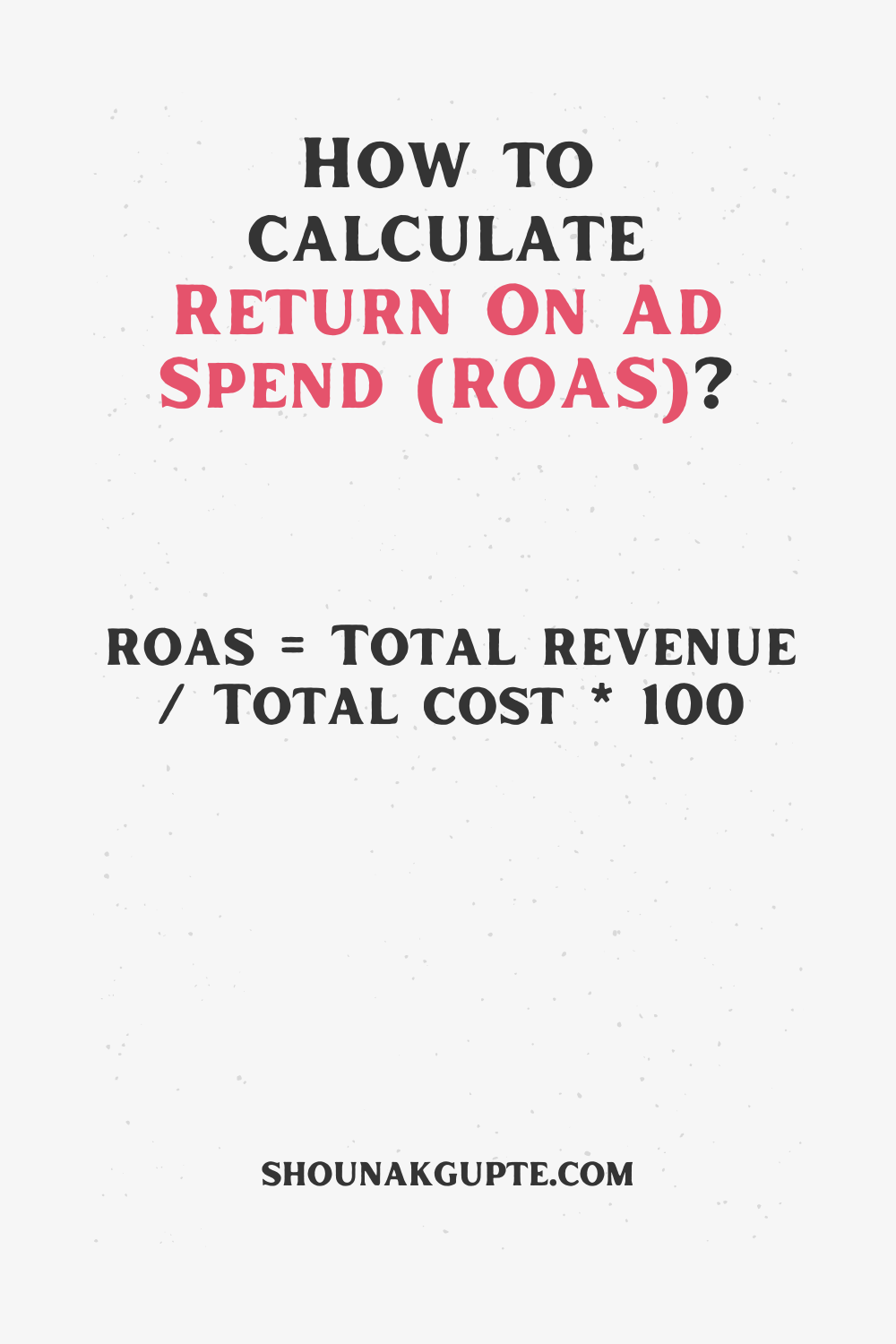
Return on AD Spend (ROAS) Formula - How To Calculate Return on AD Spend (ROAS)?
Help!
Total Cost: This is the amount of money you spent on your ad campaign. Valid inputs are any positive numbers.Total Revenue: This is the amount of money you earned from your ad campaign. Valid inputs are any positive numbers.
Return On Ad Spend (ROAS): This is the ratio of revenue to cost, expressed as a percentage. It measures how effective your ad campaign is at generating profit. It is calculated by dividing the total revenue by the total cost and multiplying by 100.
Your Input
The Return On Ad Spend (ROAS) of your ad campaign is 0%.
Benchmarks!
While there's no single "industry benchmark" for ROAS (Return On Ad Spend), here are some insights to guide you:General Benchmarks:
- Average across industries: 4:1 (meaning for every $1 spent, you generate $4 in revenue)
- Higher than 5:1: Considered excellent performance
- Lower than 2:1: May indicate need for campaign optimization
- E-commerce: 4:1 or higher
- FinTech: 2:1 - 3:1
- Healthcare: 1.5:1 - 2:5:1
- Non-profit: 1:1 or lower (prioritize impact over direct ROI)
- Consider benchmarks within your specific industry for a more accurate reference.
- Evaluate your profit margins and business goals to determine an acceptable ROAS target.
- Track your own ROAS over time and analyze factors impacting it.
- Focus on optimizing your campaigns for cost-effectiveness and achieving sustainable ROI.
Success
Related Calculators
Business ROI Calculator
From pennies to profits : Watch your business bloom with this ROI calculator!
Click HereDigital Marketing ROI Calculator
Unleash your marketing money's true potential - track campaign cash to conversion kingdom ROI!️️
Click HereEmail Marketing ROI Calculator
Turn email blasts into ROI blasts: Watch profits pop with this calculator!
Click HereGoogle Ads ROI Calculator
From clicks to cash, make your Google Ads blossom with this ROI calculator!
Click HereSEO ROI Calculator
Seed your SEO, harvest higher rankings: Watch ROI bloom with this calculator!
Click HereSocial Media ROI Calculator
From likes to leads, watch your social media blossom with this ROI calculator!
Click HereReturn on AD Spend (ROAS) Calculator FAQs
1. What exactly is ROAS, and how do I calculate it?
Think of it as your advertising efficiency meter. It measures the return you get on your advertising investment. The formula:
ROAS = Revenue Generated from Ads / Cost of Advertising
Example: If you spend $100 on ads and generate $500 in revenue from those ads, your ROAS is 5:1, meaning you make $5 for every $1 spent.
2. What's considered a "good" ROAS?
There's no one-size-fits-all answer. It depends on your industry, advertising goals, and profit margins. Here's a general guideline:
- E-commerce: 3:1 or higher
- SaaS companies: 4:1 or higher
- Lead generation: 2:1 or higher
Remember, context matters. Analyze your industry benchmarks and business goals to assess a "good" ROAS for you.
3. Why is ROAS so important for businesses?
It offers valuable insights:
- Advertising effectiveness: Helps you evaluate if your campaigns are generating a positive return on your investment.
- Budget allocation: Guides you on how much to spend on different advertising channels based on their ROAS.
- Campaign optimization: Identifies areas for improvement to maximize your advertising ROI.
- Financial planning: Helps you forecast future profitability based on your advertising spend and expected ROAS.
4. How can I improve my ROAS?
Multiple strategies can help:
- Optimize your ad campaigns: Target the right audience, use relevant keywords, and write compelling ad copy.
- Track and analyze results: Monitor key metrics like click-through rates, conversion rates, and ROAS for each campaign.
- Test different ad formats and channels: Experiment with different platforms, ad types, and targeting options to find what works best.
- Improve landing page conversion rates: Ensure your landing pages are optimized to convert website visitors into customers.
- Negotiate better ad rates: Research and negotiate competitive advertising rates with platforms or publishers.
Remember, continuous improvement and data-driven decision-making are key to optimizing your ROAS.
5. Are there any common mistakes to avoid when calculating or interpreting ROAS?
Absolutely! Here are some pitfalls to watch out for:
- Ignoring attribution models: Understand how you attribute conversions to different ad channels for accurate ROAS calculations.
- Focusing solely on ROAS: Consider other metrics like brand awareness and customer lifetime value for a holistic view.
- Comparing ROAS across industries: Benchmark against your industry standards, not other industries with vastly different profit margins.
- Attributing all sales to advertising: Not all sales might be directly attributable to ads, consider other marketing efforts.
6. Can small businesses benefit from using ROAS?
Absolutely! Even small businesses with limited advertising budgets can benefit from tracking and optimizing their ROAS. Every dollar spent wisely counts, and understanding your return on investment empowers you to make informed decisions.
Example: A local bakery tracks its ROAS for online ad campaigns, identifies underperforming ads, and optimizes targeting, leading to increased website traffic, conversions, and revenue.
7. What are some real-world examples of companies successfully using ROAS?
- Amazon: Uses sophisticated algorithms and A/B testing to optimize ad campaigns and achieve high ROAS across various channels.
- Dollar Shave Club: Focused on targeted ads with high conversion rates, resulting in a high ROAS and rapid customer acquisition.
- Airbnb: Utilizes dynamic pricing and targeted marketing to maximize revenue from each ad impression, leading to a strong ROAS.
These examples showcase diverse approaches to optimizing ROAS, highlighting the importance of tailoring strategies to your specific business model and target audience.
8. Is ROAS the same as ROI (Return On Investment)?
While similar, they have key differences:
- ROAS: Focuses specifically on advertising spend and its return on revenue.
- ROI: Considers the overall investment (including non-advertising costs) and its return on profit.
Both metrics are valuable, but ROAS offers a more granular view of your advertising performance.
9. What if I'm new to online advertising and have limited experience with ROAS?
Start small! Begin by tracking the performance of a single campaign and gradually incorporate ROAS analysis into your overall marketing strategy. Here are some tips:
- Focus on a simple campaign: Start with a basic ad campaign on a single platform like Google Ads or Facebook Ads.
- Use clear conversion goals: Define what constitutes a successful conversion for your campaign (e.g., website purchase, lead form submission).
- Track key metrics: Monitor impressions, clicks, conversions, and cost-per-acquisition (CPA) to understand campaign effectiveness.
- Calculate your ROAS: Use the basic ROAS formula to get a sense of your return on investment.
- Seek educational resources: Online courses, tutorials, and industry blogs offer valuable insights into ROAS and online advertising best practices.
By starting small, learning the ropes, and gradually incorporating ROAS analysis, you can gain valuable insights and optimize your advertising efforts for better results.
10. What are some advanced ROAS optimization strategies for experienced marketers?
Once you've mastered the basics, explore these advanced techniques:
- Dynamic bidding: Leverage automated bidding strategies that optimize bids based on real-time conversion probability.
- Audience segmentation: Create targeted ad campaigns for different audience segments with varying conversion potential.
- Retargeting campaigns: Reach website visitors who haven't converted yet with personalized ads.
- Attribution modeling: Utilize advanced attribution models to accurately assign credit for conversions across multiple touchpoints.
- A/B testing: Test different ad variations, landing pages, and targeting options to identify the best performing options.
Remember, continuous experimentation, data analysis, and adapting your strategies based on insights are crucial for optimizing your ROAS in the ever-evolving digital advertising landscape.
